Help Topics
Browse by category and pick the guide that matches what you need to do.
Getting Started
Collection Management
Decks & Decklists
Markets & Alerts
Account & Support
Getting Started
Collection Management
Decks & Decklists
Markets & Alerts
Account & Support
Deck Analysis
Every Commander deck page has a Deck analysis section below the decklist. Use the Analysis button above the decklist to jump to it. It reads your commanders and mainboard, not your sideboard or maybeboard, and updates when you change the deck.


Most rows can be clicked to see the cards behind the number, so you can check a count or find a card to swap. The numbers are guides. A deck with an unusual plan can look odd here and still play well. Each card's Learn more link opens its part of this page.
What do you want to know?
- How strong does this deck look? See Bracket.
- Does it have enough ramp and card draw? See Roles.
- Can it answer what opponents do? See Disruption.
- Can I cast my spells on time? See Mana.
- How often will I get a playable start? See Opening hand.
- Does it have combos, or nearly have them? See Combos.
This estimates which Commander Bracket the deck fits, so you can tell your table what to expect. It only uses the bracket rules that can be checked from a decklist. A deck that meets none of them is estimated at Bracket 2, and a deck that meets several takes the highest.
| The deck has | Bracket |
|---|---|
Up to three Game Changers | 3 |
Four or more Game Changers | 4 |
Mass land denial or chained extra turns | 4 |
A two-card combo | 3 |
A two-card combo that needs four mana or less | 4 |
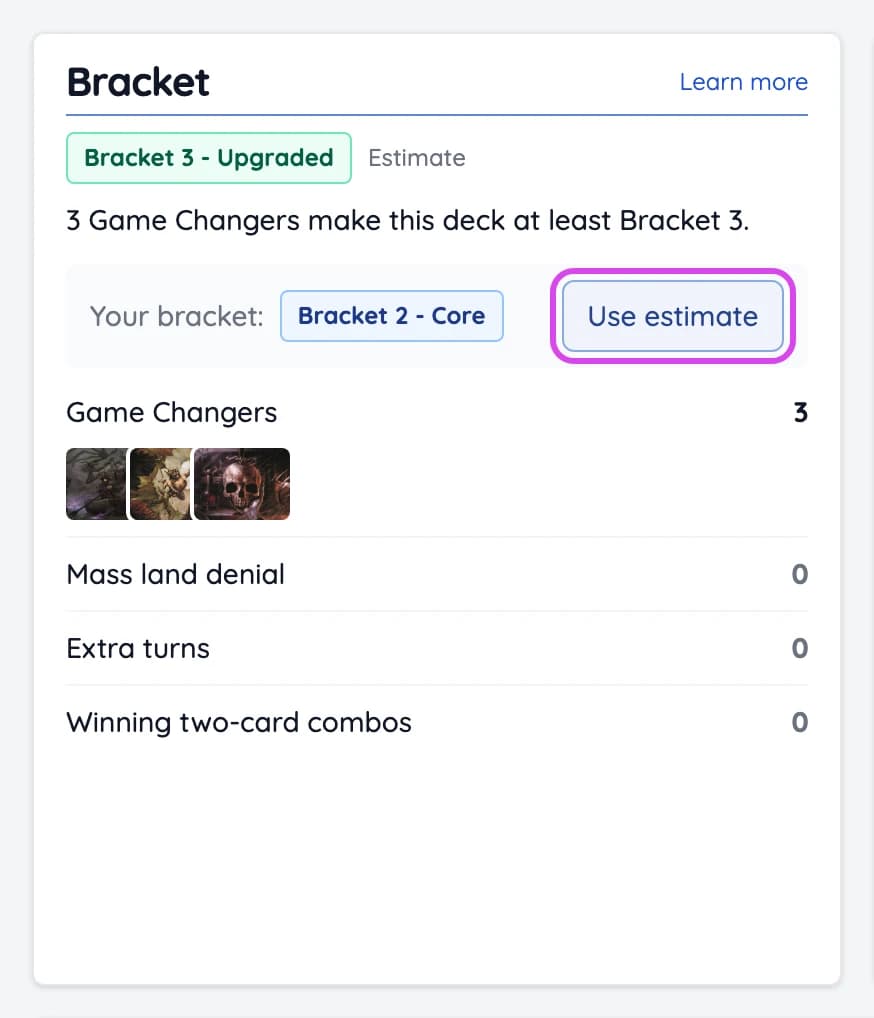
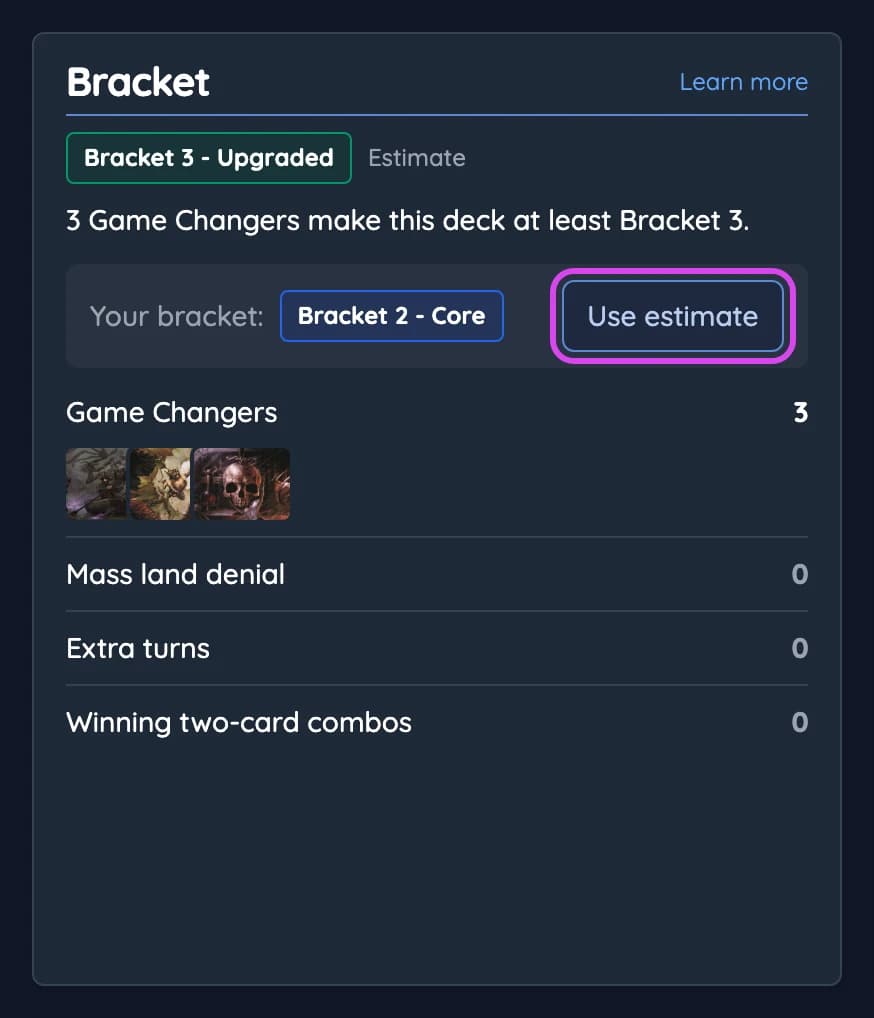
To change the estimate, look at the sentence under the badge. It names the rule that set the bracket. For example, a deck with four Game Changers drops out of Bracket 4 when you cut one, as long as no other rule keeps it there.
Brackets 1 and 5 depend on how you build and play, so they are never estimated. The estimate never changes your deck's own bracket. Deck owners can copy it with Use estimate.
Roles show which jobs your cards do. Use them to spot a job the deck has too few cards for. The bars compare the roles with each other, not with a target, because what a deck needs depends on its plan.
| Role | What it counts |
|---|---|
Ramp | Gives you more mana or lands. |
Card draw | Gets you more cards, including cards you exile and play. |
Interaction | Removal, board wipes and counterspells, split out under Disruption. |
Tutors | Find a card from your library. Cards that only find lands don't count. |
Protection | Keeps your permanents or spells safe. |
Reanimation | Puts creatures from a graveyard onto the battlefield. |
Recursion | Gets other cards back from your graveyard. |
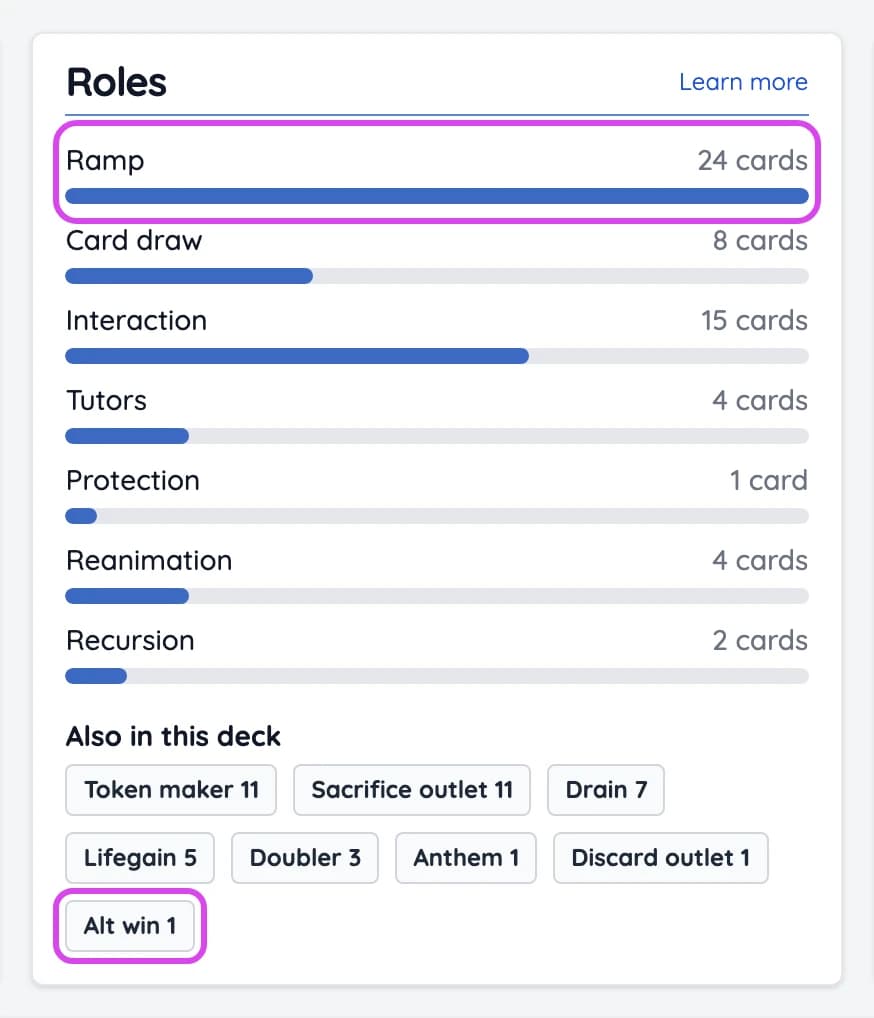
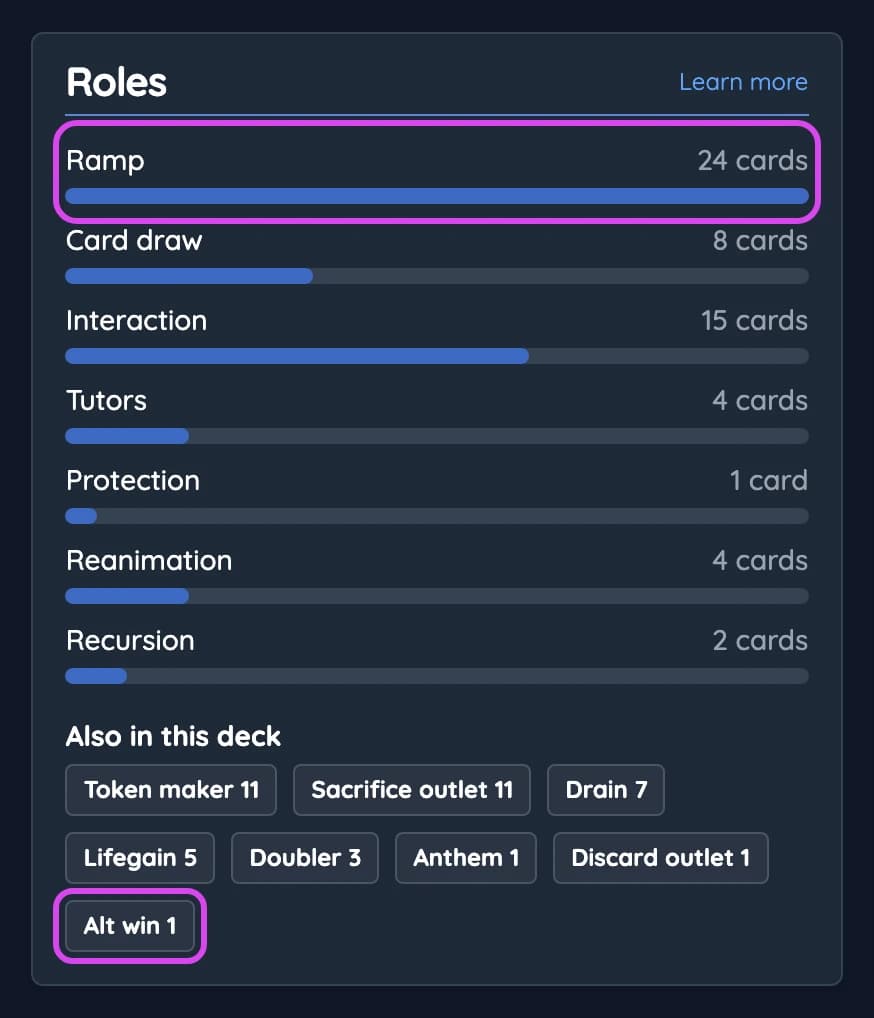
A card counts in every role it fits, so the numbers can add up to more than your card count. The One Ring is both Card draw and Protection. Also in this deck lists themes beyond the main roles, such as Token maker or Lifegain. Click one to see its cards.
Roles come from the card tags on Scryfall Tagger, which players maintain. They describe the card, not how you use it, and very new cards can be missing.
Your own roles
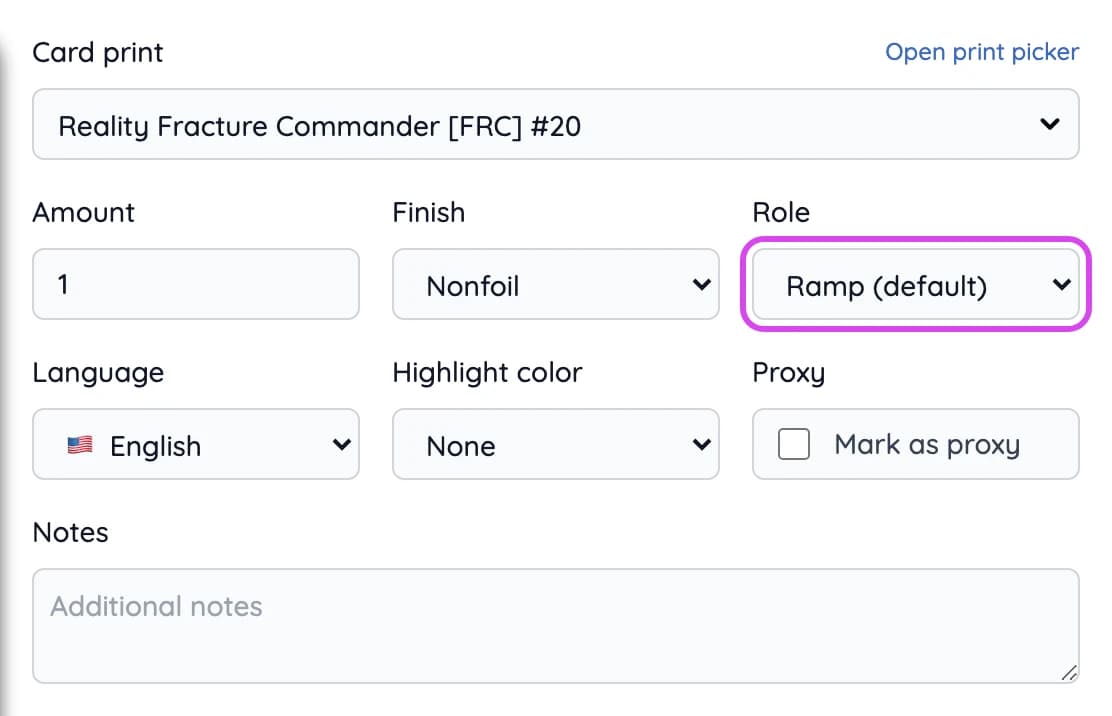
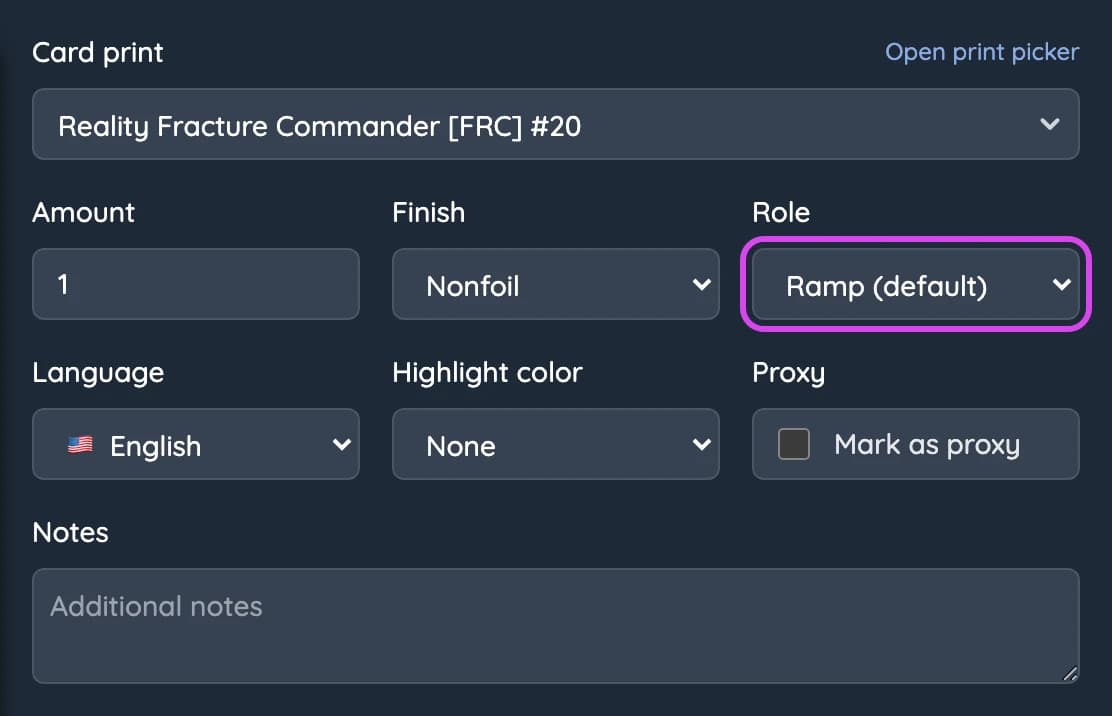
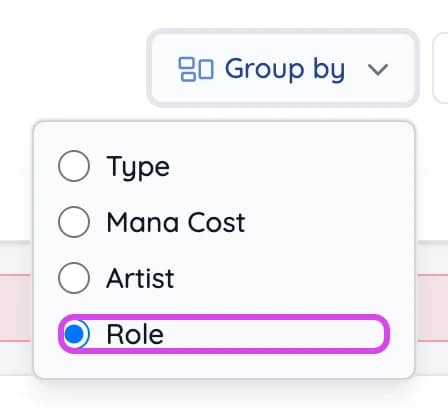
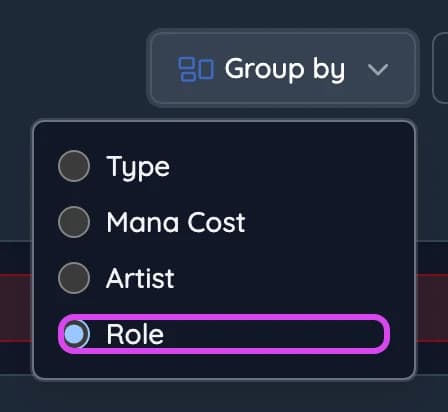
To say what a card does in your deck, edit it and pick a Role. The card then counts in that role as well as its Scryfall roles. The first option, such as Ramp (default), keeps only the Scryfall roles and names the card's first one. To see your decklist by role, choose Role under Group by. Each card shows once, under the role you picked or else its first Scryfall role.
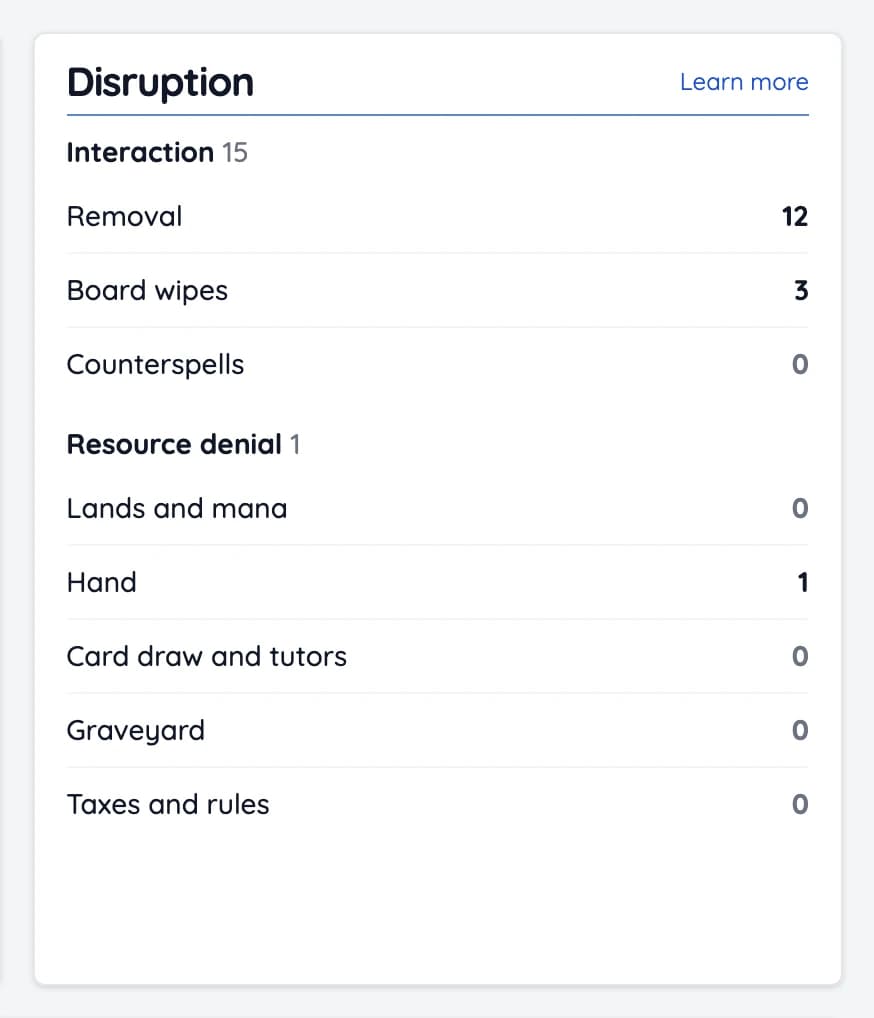
This shows how the deck deals with other players, in two groups.
Interaction
These cards answer something an opponent already did: removal for one threat, board wipes for many, and counterspells for a spell on the stack. Each card counts once, in this order: board wipe, then removal, then counterspell.
Resource denial
These cards limit what opponents can do in the first place. Each row is what they take away:
| Row | Cards that |
|---|---|
Lands and mana | Destroy lands, or punish nonbasic lands and ramp. |
Hand | Make opponents discard. Wheels refill every hand, so they don't count. |
Card draw and tutors | Stop or punish drawing and searching. |
Graveyard | Exile graveyards or stop them being used. |
Taxes and rules | Make spells cost more, limit how many can be cast, or shut off abilities. |
A card can sit in several rows, but the group total counts it once. A card can also be both interaction and resource denial, so don't add the two totals together.
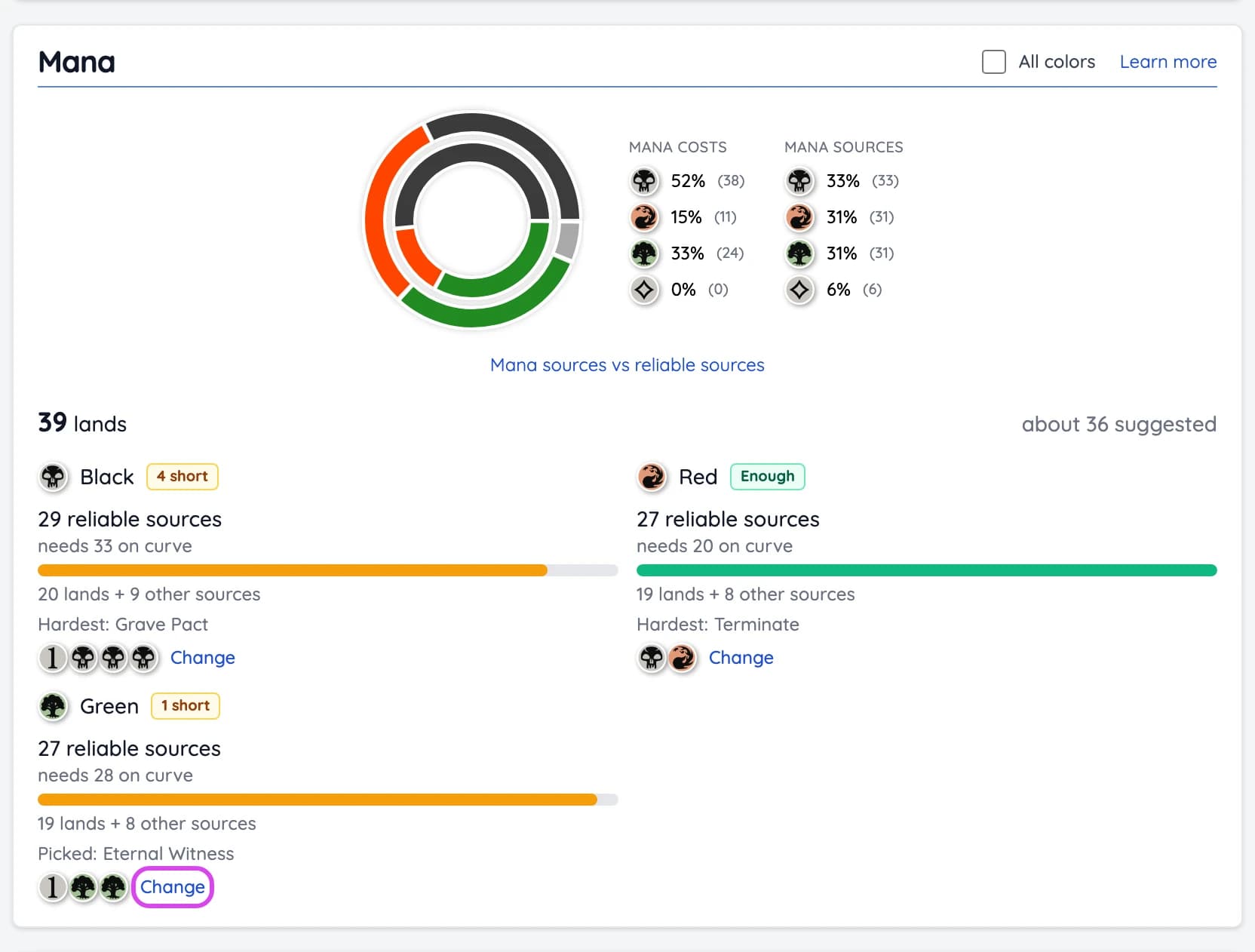
This shows whether your lands and mana cards can pay for your spells on time.
The rings
The rings compare the colors in your mana costs with the colors your cards can make. If a color takes up much more of your costs than of your sources, that color is the first one to look at. They count your sources differently from the columns below them; see Mana sources vs reliable sources.
Suggested lands
The suggestion goes up with the deck's average mana value, and down for each piece of ramp or card draw that costs two mana or less. It says how many lands to play, not which colors they should make.
Sources and on curve
Each color shows its reliable sources: how many you can count on early in a game. Cards that are slower or less certain than a land count as part of one:
| Card | Counts as | For example |
|---|---|---|
A land that makes the color | 1 | Overgrown Tomb |
A fetch land, for each color it can find among your lands | 1 | Wooded Foothills |
A land that makes you pick one color | 1 in two colors, ⅔ in more | Fabled Passage, a Pathway |
A mana rock | ¾ | Arcane Signet |
A mana creature | ½ | Birds of Paradise |
A spell that puts a land onto the battlefield | ¾ at two mana, ½ at three | Rampant Growth, Cultivate |
A spell with a land on its back | 0.8, or 1 if it's mythic | Bala Ged Recovery |
A card that depends on what opponents play | ¾ or ½ of every color | Exotic Orchard, Fellwar Stone |
Treasure makers, rituals, card draw and scry | Nothing | Dark Ritual |
Everything that isn't a land is an other source, and the total is rounded down.
Casting a spell on curve means casting it on the turn that matches its mana value, such as a six-mana spell on turn six. Needs is how many sources of that color give you about a 90% chance of doing that with the Hardest card, a little more for expensive spells. It only counts games where you have drawn enough lands by then, so it asks whether your lands make the right colors. Whether you have enough lands at all is what Suggested lands answers.
How the Hardest card is chosen
Every card with the color in its cost gets a number of sources it needs, and the Hardest card is the one with the highest. Ties go to the first name alphabetically, and the Change list is sorted the same way. Two things set the number: how many symbols of the color the cost has, and how early the card is cast.
Why Bloodghast needs more than Butcher of Malakir
Needs answers one question: when you have enough lands to cast the card on its turn, how often are enough of them the right color? It assumes you already hit your land drops, which is what Suggested lands measures.

 Cast on turn 2.You have 2 lands, and both must make black.Needs 30 black sources.

 Cast on turn 7.You have 7 lands, and only 2 of them must make black.Needs 20 black sources.
With 30 black sources in 99 cards, both of your first two lands make black about 90% of the time; with fewer, they don't. Two black lands among seven is much easier, so 20 is enough for Butcher.
Butcher is harder to pay for, since it needs seven mana, but that's the land count's job. Bloodghast is harder on your colors, and that's all this column measures. So the Hardest card is the one most demanding on that color, and cheap cards with several symbols of one color usually win.
A multicolor card is measured in each of its colors, with its other colors treated as generic mana, and needs one more source in each, because you need all of its colors at once. Terminate needs 20 black and 20 red sources, so it can be the Hardest card in either color. Hybrid and Phyrexian symbols aren't counted. Spells with X in their cost are never picked as the Hardest card on their own, because on curve they would be cast with X as 0.
Cards with more than one spell, such as adventures, split cards and cards with a spell on each side, are measured by each spell's own cost and mana value, and count as their hardest one. Stomp, Bonecrusher Giant's adventure, costs 
 and is cast on turn two, so it needs 19 red sources, more than the Giant itself. The column then names the spell, not the card.
Colorless. A  symbol can only be paid with colorless mana, such as from Wastes, Sol Ring or most utility lands. When a spell in the deck has one, as many Eldrazi do, the card shows a Colorless column measured like a color. The number in a cost is generic mana, which any mana pays, so it isn't counted anywhere.
Picking the Hardest card. The deck's owner can choose another card for a color with Change, such as leaving out a card they never need early or counting an X spell. The column then says Picked. Removing that card from the deck, or choosing Automatic, goes back to the card the analysis picks.
For example, Consecrated Sphinx costs six mana, two of it blue, which needs 22 blue sources. A deck with 17 reliable blue sources shows 5 short. That doesn't mean you can't cast it, only that it will often come later than turn six.
If a color is short, swap a land for one that makes that color, add a mana rock that makes it, or replace the Hardest card with one that has fewer colored symbols. In a three-color deck it's normal to fall short on a card you don't need early, so check whether being late with it matters.
Where the numbers come from
The sources each card needs and what counts as a source come from Frank Karsten's How Many Sources Do You Need to Consistently Cast Your Spells? A 2022 Update, using his table for 99-card decks. The suggested lands use the 99-card formula from his How Many Lands Do You Need in Your Deck? An Updated Analysis. We follow both, except here:
| Karsten | MythicHub |
|---|---|
A multicolor card also needs enough sources that make any of its colors. | Not checked. In a deck of three colors or fewer, almost every land makes one of them. |
A splashed multicolor card, whose other color is in nearly every land, needs no extra source. | Always one more source. |
Hybrid symbols need enough sources that make either color. | Hybrid symbols aren't counted. |
Convoke, delve, cost reducers and X spells count the mana you usually pay. | The printed cost. X spells are left out of Automatic, and Change picks another card. |
Mana creatures, mana rocks and ramp spells only help spells that cost more than they do. | They count toward every card. |
A Treasure counts as ¼ of a source, and cheap card draw as part of one. | Neither counts. |
For a one-mana spell, only lands that enter untapped count. | Tapped lands count too. |
For the suggested lands, a spell with a land on its back counts as part of a land. | Your land count includes only lands. |
The Mana card counts your sources twice, for two different questions. The rings ask which colors your deck makes, so every card that can make a color counts as one full source of it. The reliable sources under them ask how many you can count on early in a game, so slower or less certain cards count as part of a source. That's why the rings usually show more.
| Card | Rings | Reliable sources |
|---|---|---|
A land that makes the color | 1 | 1 |
A fetch land, such as Wooded Foothills | 1 for each color it finds | 1 for each color it finds |
A land that makes you pick, such as Fabled Passage or a Pathway | 1 for each color | 1 in two colors, ⅔ in more |
A mana rock, such as Arcane Signet | 1 | ¾ |
A mana creature, such as Birds of Paradise | 1 | ½ |
A land-search spell, such as Rampant Growth or Cultivate | 0 | ¾ or ½ |
A spell with a land on its back | 1 | 0.8, or 1 if mythic |
Exotic Orchard or Fellwar Stone | 1 of every color | ¾ or ½ |
A ritual, such as Dark Ritual | 1 | 0 |
A colorless source, such as Sol Ring | 1 colorless | ¾ in the Colorless column, if the deck has one |
The rings also leave out colors outside your commander's colors unless you tick All colors, and they work on any deck, while the reliable sources are only for Commander decks.
This shows how often the deck gets off to a working start. The odds are for a random seven-card hand from your library, leaving out your commanders and any mulligans. You draw on your first turn in Commander, so by turn two you have seen nine cards and by turn four eleven.
To raise a number, add more cards of that kind. Each row uses the same counts as Roles and Disruption.
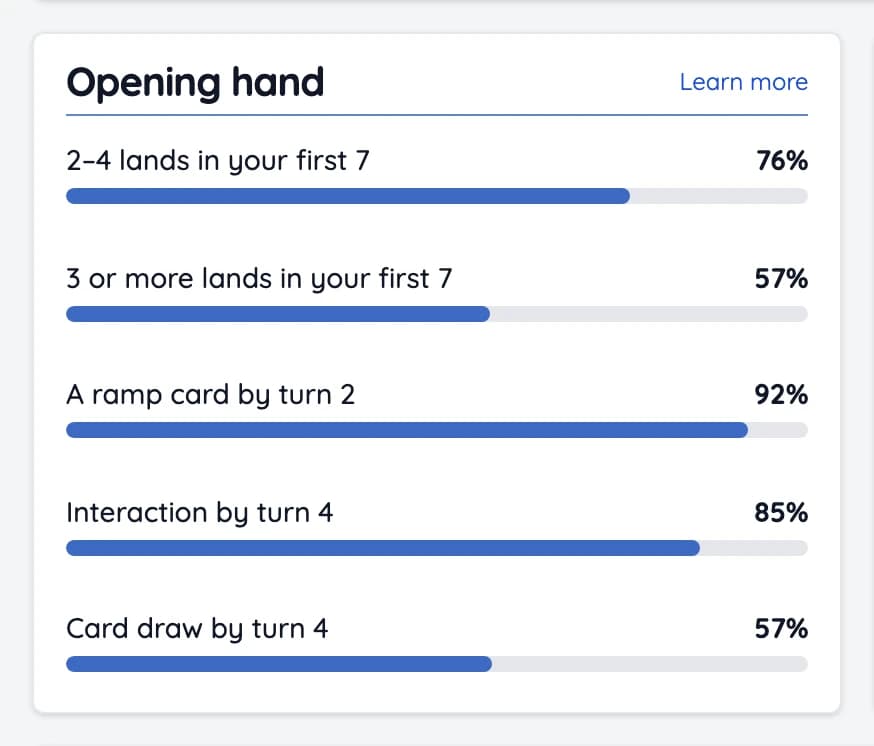
| Row | How often |
|---|---|
2–4 lands in your first 7 | You can keep a hand without too few or too many lands. If it's low, look at your land count. |
3 or more lands in your first 7 | You start with lands to spare. It matters most for decks that need a lot of mana early. |
A ramp card by turn 2 | You have at least one ramp card in time to get ahead on mana. |
Interaction by turn 4 | You have at least one answer by the time opponents start to threaten you. |
Card draw by turn 4 | You have at least one way to refill your hand. |
Combos come from Commander Spellbook. In this deck lists the combos you can already assemble. One card away lists combos you could add with a single card your colors allow, which is useful for finding upgrades, or for seeing what you might include by accident. Combos that use a card banned in Commander are left out of One card away.Add puts a missing card in your mainboard, from its One card away row or from a combo's steps. Only you see One card away on your own decks; on someone else's deck the card lists the combos it already has.
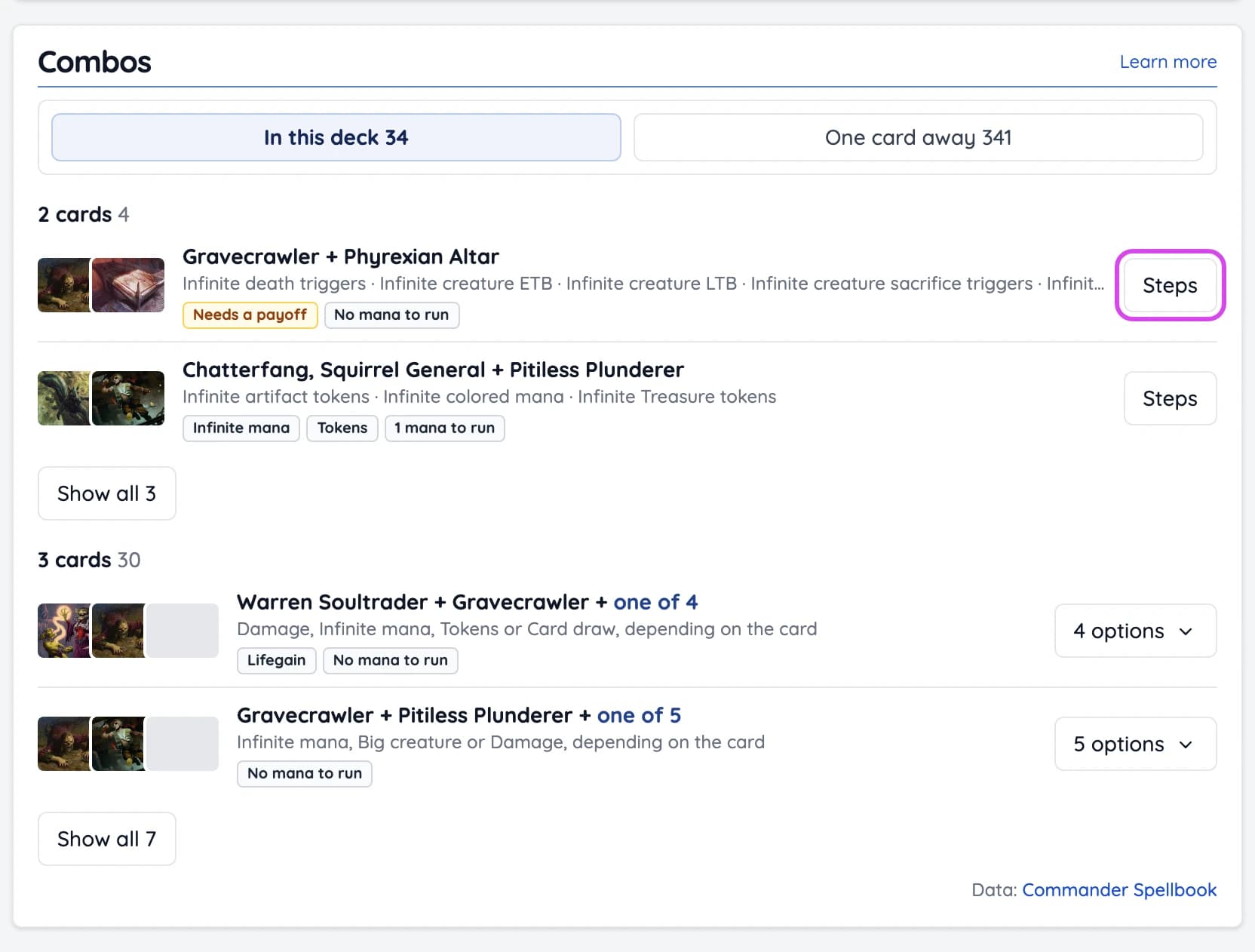
Combos are grouped by how many cards they need, most popular first. Click a card name to see the card, or Steps for what to do, what must be true before you start, and what you get.
Combos that need the same cards except one share a row, such as two creatures plus one of 5 sacrifice outlets. Click 5 options to see each choice, what it does and its steps. Each choice shows the shared cards in grey and its own card in blue. One card away lists the cards you could add, the ones that complete the most combos first, each with its first three combos.
| You see | It means |
|---|---|
Orange name | A card missing from your deck. |
Blue name | A kind of card, not a named one, such as a cheap permanent. Check that your deck has one. These combos never count as two-card combos for the bracket. |
Infinite mana | What the combo does, based on the results Commander Spellbook lists, so an unusual result may have no tag. |
1 mana to run | The mana you need available to run the combo, as Commander Spellbook lists it. Cards that must already be on the battlefield aren't included. |
Needs a payoff | The combo only repeats triggers, such as creatures dying over and over. Nothing happens until another card uses those triggers. |