Help Topics
Browse by category and pick the guide that matches what you need to do.
Getting Started
Collection Management
Markets & Alerts
Account & Support
Getting Started
Collection Management
Markets & Alerts
Account & Support
Importing collection
Importing your Magic: The Gathering collection from other platforms to MythicHub is a seamless process designed to help you keep all your cards in one place. Whether you're consolidating collections, importing wishlists, or transferring specific deck inventories, MythicHub supports imports from over a dozen popular platforms.
This feature is available to logged-in users directly from the Collection page. To import a wishlist, use Import wishlist on the Wishlists page instead. Imported prices become desired prices in a wishlist. The import process maintains data integrity as much as possible while providing detailed feedback on any potential issues.
You can select one collection file, or up to 20 CSV or TXT files exported from the same source. MythicHub shows the detected source for each file before importing. Multi-file batches can be up to 25 MB in total and are imported into one binder with one combined summary. Helvault backup files must be imported one at a time.
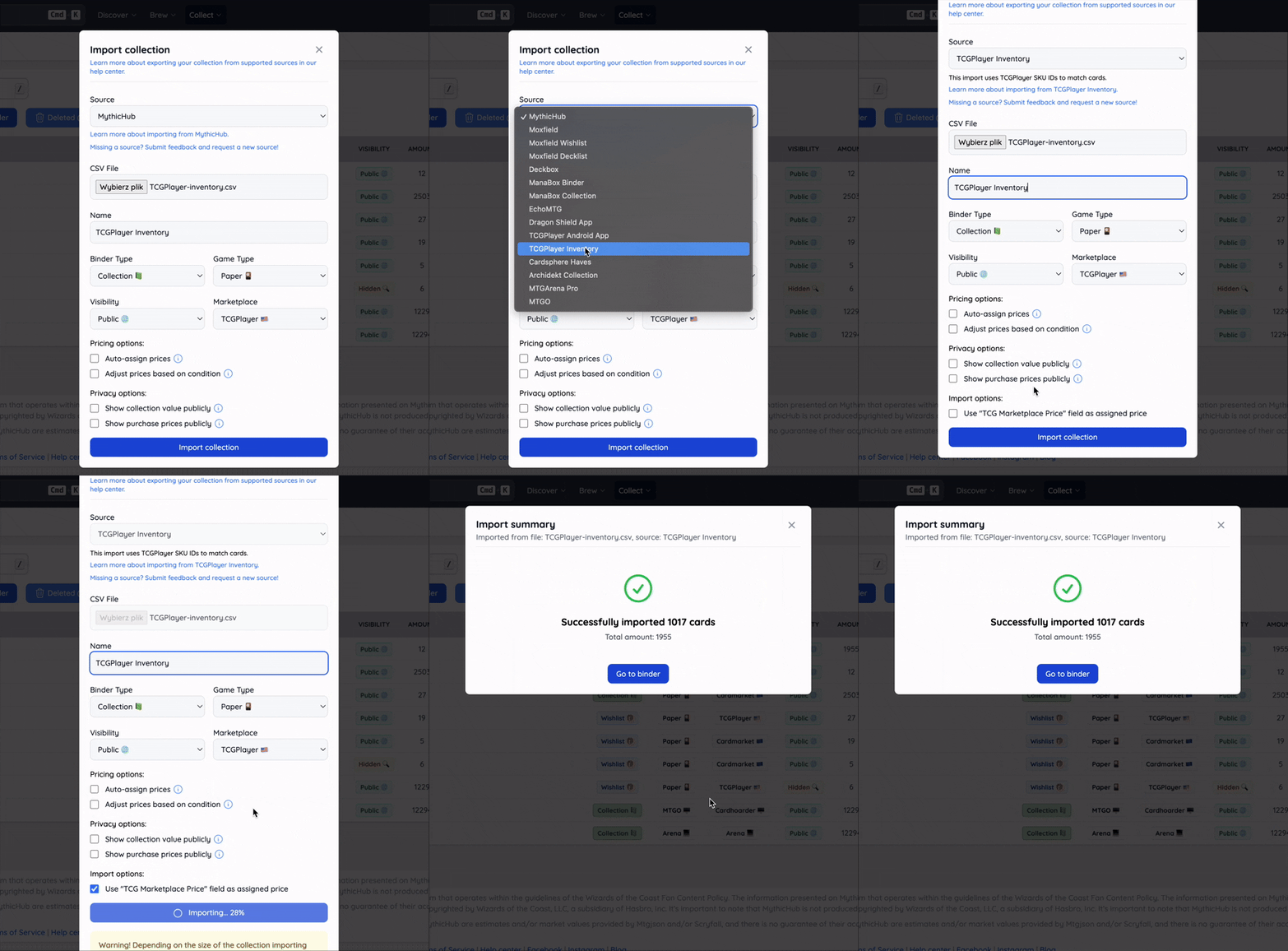
Import Process Overview
MythicHub's import system has been designed with user experience in mind, providing detailed feedback throughout the entire process:
- Automated Validation: CSV files are automatically checked for required columns
- Import Summary: Detailed summary shows exactly what was imported successfully
- Error Handling: Clear feedback on cards that couldn't be matched, with options to export unmatched cards
- History Tracking: All imports are logged in your binder history for future reference
- Auto-Assign Prices: Option to automatically set current market prices as assigned prices during import
Supported Import Sources
MythicHub supports importing from over a dozen platforms, each optimized to preserve as much detail as possible from your original collection data. Sources include Archidekt, ManaBox, Moxfield, TCGplayer, and other collection tools with detailed export formats.
- Navigate to the Collection Page:
- Ensure you are logged into your MythicHub account.
- Go to the Collection page where you manage your cards.
- Select the Import Option:
- On the Collection page, find and click the "Import Collection" button.
- You will be presented with various options to import your collection from different web apps.
- Configure Your Binder Settings:
- When importing, you can set all the same properties as when you create a new binder:
- Binder Type: Choose the type of binder that best suits your collection.
- Game Type: New collection binders track paper cards.
- Visibility: Decide whether your binder will be public, private or hidden.
- Marketplace for Prices: Select the marketplace from which you want to take prices for your cards.
Importing your Magic: The Gathering collection from ManaBox to MythicHub is designed to be straightforward. There are two ways to import your cards from ManaBox:
Method 1: Importing a Single Binder
- Export Your Binder from ManaBox:
- Open ManaBox on your device.
- Navigate to the specific binder you want to export.
- Tap the menu button (three dots) in the top right corner.
- Select “Export”.
- Choose “CSV” as the export format.
- Save the exported file to your device.
- Import to MythicHub:
- In MythicHub, go to the Collection page.
- Click “Import Collection”.
- Select “ManaBox Binder” as the import source.
- Upload your exported CSV file.
Method 2: Importing Your Entire Collection
- Export Your Collection from ManaBox:
- Open ManaBox on your device.
- Navigate to your collection.
- Tap the menu button (three dots) in the top right corner.
- Select “Export”.
- Choose “CSV” as the export format.
- Save the exported file to your device.
- Import to MythicHub:
- In MythicHub, go to the Collection page.
- Click “Import Collection”.
- Select “ManaBox Collection” as the import source.
- Upload your exported CSV file.
- All cards will be imported into a single binder with the original ManaBox binder name added as a note to each card.
Limitations and Important Notes:
- Card Conditions: Card conditions from ManaBox are mapped to MythicHub as follows:
- Mint -> Near Mint
- Near Mint -> Near Mint
- Excellent -> Lightly Played
- Good -> Moderately Played
- Light Played -> Moderately Played
- Played -> Heavily Played
- Poor -> Damaged
Importing your Magic: The Gathering collection from Moxfield to MythicHub is designed to be straightforward, but there are some important details to keep in mind. Here's what you need to know to ensure a smooth import process:
Limitations and Important Notes:
- Set Names and Codes: Moxfield set names and codes should generally align with those used by MythicHub. However, there might be some discrepancies that could affect the import process.
- Collection Types: You can import your Moxfield collection or a Moxfield deck directly into a MythicHub binder, and your Moxfield wishlist into a MythicHub wishlist.
- Tradelist Count: Tradelist counts from Moxfield will not be transferred to MythicHub.
- Assigned Prices: Moxfield purchase prices will be properly imported. In a binder they become assigned prices, with the currency of the selected marketplace. In a wishlist they become desired prices, which have no currency.
- Card Languages: Moxfield allows assigning languages to cards that may not exist. If this occurs, the card will default to English in MythicHub.
- Card Conditions: Card conditions from Moxfield are mapped to MythicHub as follows:
- “Mint > Near Mint”
- “Good (LP) > Lightly Played”
- “Played > Moderately Played”
- “Heavily Played > Heavily Played”
- “Damaged > Damaged”
Exporting Your Inventory from Moxfield:
To export your collection from Moxfield for import into MythicHub:
- For Collection:
- Go to the Collection page.
- Click "More" and select "Export CSV".
- Download the CSV file containing your collection data.
- For Wishlist:
- Go to the Wishlist page.
- Click "More" and select "Export".
- In the dialog, click "Copy for Moxfield".
- Paste the copied text into the import dialog textarea in MythicHub.
- For Deck:
- Go to the deck that you want to export.
- Click "More" and select "Export".
- In the dialog, click "Copy for Moxfield".
- Paste the copied text into the import dialog textarea in MythicHub.
Exporting and importing data within MythicHub allows you to manually manipulate your data outside the application if needed. Since this is the same application, card identities and metadata can be carried between exports and imports.
How to Export Your Data:
To export a binder from MythicHub:
- Navigate to the binder you want to export
- Find the Actions dropdown menu
- Select "Export cards" for active cards or "Export sold cards" for sold-card records
- A CSV file containing your binder data will be downloaded
How to Import MythicHub Data:
To import a MythicHub CSV file:
- Go to your Collections page
- Click the "Import" button
- Select "MythicHub" for active-card CSVs or "MythicHub Sold Cards" for sold-card CSVs
- Upload your CSV file
- Follow the on-screen instructions to complete the import
Wishlist CSVs use Desired Price without a currency column. Older Assigned Price columns are accepted; when both exist, Desired Price wins, even when empty. Old currency columns are ignored without conversion. The active marketplace determines how the preserved number is displayed.
Use Cases:
- Personal Backup: Create an additional backup of your collection data
- Bulk Modifications: Make changes to multiple cards at once using spreadsheet software
- Collection Analysis: Analyze your collection data using external tools
- Sharing Collections: Share your binder with friends who can import it into their own MythicHub account
Important Notes:
- All data is preserved exactly as it appears in MythicHub, including:
- Card quantities
- Conditions
- Languages
- Set information
- Assigned prices
- Custom notes
- Extra info
- Sold-card CSV imports create sold-card entries only. Learn how sold-card tracking works.
- You can modify the exported CSV file using any spreadsheet software before importing it back
- The CSV format makes it easy to perform bulk updates to your collection data if needed
- You can import your own modified binder or receive a binder from another MythicHub user
Import your collection from Mythic Tools using the CSV export format. MythicHub prefers Scryfall IDs for exact matching across languages and printings. When an ID is missing, it uses the English card name, set code, and collector number instead.
Imports work for both Mythic Tools container types (boxes and binders). You can also export your entire collection (all boxes and binders in a single CSV) and import it in one pass.
How to Import from Mythic Tools:
- Export your collection as CSV from Mythic Tools
- Go to Collections in MythicHub
- Click Import
- Select "Mythic Tools" as the source
- Upload the CSV file and complete the import
Mapping Details:
- Card matching: Uses
Scryfall IDfor exact matching whenever one is available. - Rows without Scryfall ID: Fall back to
English Name(orCard Name),Set Code, andCollector Number. Rows that still cannot be matched appear in the import summary so you can copy them. - Languages: Language codes (for example
en,de,fr,ja,pt,ru,zhs,zht) are mapped to MythicHub language names. - Conditions: Mythic Tools condition values are mapped to MythicHub condition tiers.
- Finishes:
nonfoil,foil, andetchedare imported. - Assigned price: Always imported as empty.
- Optional notes: You can choose to import container names (
Container Name) into card notes. - Extra info:
Altered,Signed, andMisprintboolean fields are mapped when set to true.
MythicHub supports two Helvault export formats: Helvault backup files (.helvault) and CSV exports.
In Helvault, export your collection as either their backup file or CSV, then import that file into MythicHub.
Option 1: CSV import
- Export your collection from Helvault as a CSV file.
- In MythicHub, open your Collection page.
- Click Import collection.
- Select Helvault CSV as source.
- Upload the CSV file and import.
Option 2: Backup file import
- Export your collection from Helvault as their backup file.
- In MythicHub, open your Collection page.
- Click Import collection.
- Select Helvault Backup File as source and upload the
.helvaultfile.
Mapping Details
- Card matching: Uses Scryfall ID when available.
- Condition: Defaults to Near Mint.
- Finish mapping: Etched signals map to etched; foil signals map to foil; all other cards map to nonfoil.
- Assigned price: Imported as empty.
Importing your Magic: The Gathering collection from Dragon Shield to MythicHub is designed to be straightforward, but there are some important details to keep in mind. Here's what you need to know:
Limitations and Important Notes:
- Card Languages: Dragon Shield app allows assigning languages to cards that may not exist. If this occurs, the card will fallback to the default card language in MythicHub.
- Card Finishes: Dragon Shield allows assigning foil finishes to cards that do not have foil versions, and etched cards are marked as foil. MythicHub verifies if the assigned finish exists, and if not, defaults the card to nonfoil or other available finish.
- Card Conditions: Card conditions from Dragon Shield are mapped to MythicHub as follows:
- Mint > Near Mint
- Near Mint > Near Mint
- Excellent > Lightly Played
- Light Played > Lightly Played
- Good > Moderately Played
- Played > Heavily Played
- Poor > Damaged
Exporting Your Inventory from Dragon Shield:
To export from Dragon Shield Mobile App, open the mobile app, go to Inventory, and locate the folder you wish to export. Tap the three dots in the top-right corner of the folder and select "Export".
To export from the Dragon Shield Web App, navigate to Inventory via the left menu or panel. Locate and click the Export button to download the CSV file. To export a specific folder, either click the export icon next to the folder in the inventory listing or open the folder and use the Export button inside.
Archidekt is a beloved deck building and collection management tool known for its intuitive interface and robust features. MythicHub's Archidekt import is designed to seamlessly transfer your carefully curated collection while preserving important details like conditions, purchase prices, languages, and foil status.
💡 Optimization Tip: For the most accurate import results, ensure your Archidekt export includes the Scryfall ID field. This minimizes manual corrections after import and provides the highest matching accuracy.
Key Import Features:
- High-Accuracy Matching: When Scryfall IDs are included in your export, the majority of cards import without errors, ensuring precise card identification
- Purchase Price Preservation: Archidekt purchase prices are automatically imported as assigned prices in MythicHub, maintaining your cost tracking data
- Complete Condition Support: All card conditions are accurately mapped and preserved during the import process
- Language Support: Card languages are preserved where possible, with intelligent fallback to available options
- Foil Status Detection: Foil and non-foil variants are correctly identified and imported
Important Technical Notes:
- Scryfall ID Requirement: Including the Scryfall ID field in your export is crucial for optimal matching accuracy and minimal import errors.
- Purchase Price Integration: Purchase prices from Archidekt are imported as assigned prices when you import into a binder, using the currency of your marketplace selection. When you import into a wishlist, they become desired prices, which have no currency.
- Card Languages: Archidekt allows assigning languages to cards that may not exist in the official Magic: The Gathering database. If this occurs, the card will default to English in MythicHub. If English is not available, the card will default to the next available language.
- Card Conditions: Card conditions from Archidekt are mapped to MythicHub as follows:
- “Near Mint (NM) > Near Mint”
- “Lightly Played (LP) > Lightly Played”
- “Moderately Played (MP) > Moderately Played”
- “Heavily Played (HP) > Heavily Played”
- “Damaged (D) > Damaged”
- Labels: Labels assigned to cards in Archidekt will not be imported into MythicHub.
Exporting Your Inventory from Archidekt:
To export your collection from Archidekt for import into MythicHub:
- Log in to your Archidekt account.
- Navigate to your collection.
- Click on the "Export" button, located below the collection name.
- When choosing the CSV fields, ensure that the "Scryfall ID" field is selected. Leaving the default selection is also acceptable if it includes Scryfall ID.
- Save the CSV file to your computer.
- In MythicHub, go to your Collection page and click on the "Import Collection" button.
- Select "Archidekt Collection" as the import source, choose the CSV file you downloaded, and fill in the binder details.
- Click on "Import collection" to start the import process.
Importing your Magic: The Gathering collection from Deckbox to MythicHub comes with a few limitations due to differences in set names, codes, and card attributes between the two platforms. Here's what you need to know to ensure a smooth import process:
Limitations and Important Notes:
- Set Names and Codes: Deckbox uses its own version of set names and codes that do not align with those used by MythicHub. Because of this, we are unable to map these sets correctly, resulting in only a partial import of your collection.
- Cards Without Set Assignments: Any cards in your Deckbox inventory that do not have a set assigned will not be imported into MythicHub.
- Foil and Etched Foil Cards: Deckbox provides dedicated cards for etched versions if a single card printing has multiple finishes. These cards might not import correctly. If a card has a dedicated etched printing in both MythicHub and Deckbox, it will import correctly but may be missing the etched property after importing.
- Proxy Cards: Proxy cards in Deckbox are indicated through their condition. When imported to MythicHub, these cards will be marked as proxy cards with a near mint condition.
- Card Conditions: Card conditions from Deckbox are mapped to MythicHub as follows:
- Mint -> Near Mint
- Near Mint -> Near Mint
- Good (LP) -> Lightly Played
- Played -> Moderately Played
- Heavily Played -> Heavily Played
- Poor -> Damaged
- Card Languages: If a card in Deckbox is assigned a language that does not exist in MythicHub, it will default to English upon import.
- Tradelist Count, Assigned Prices and Tags: Tradelist counts, tags and any prices assigned to cards in Deckbox will not be transferred to MythicHub.
Exporting Your Inventory from Deckbox:
To export your collection from Deckbox for import into MythicHub:
- Go to Your Deckbox Inventory:
- Log in to your Deckbox account.
- Navigate to your inventory.
- Export Your Collection:
- In the top right corner, hover over the "Tools" menu.
- Select "Export" from the dropdown options.
- Download the CSV file containing your inventory data.
To successfully import your Magic: The Gathering collection from EchoMTG to MythicHub, it's essential to understand the process and its limitations. Here's what you should know before you start:
Limitations and Important Notes:
- Card Languages: EchoMTG allows assigning languages to cards that may not exist. If this occurs, the card will fallback to the default card language in MythicHub.
- Card Finishes: EchoMTG allows assigning foil finishes to cards that do not have foil versions, or nonfoil to etched versions of cards. MythicHub verifies if the assigned finish exists, and if not, defaults the card to nonfoil or other available finish.
- Card Conditions: The card conditions used by EchoMTG are the same as those used by MythicHub. However, EchoMTG includes some additional options for card conditions, which are mapped to MythicHub's extra info as follows:
- ALT -> Alter
- ART -> Artist Proof
- SGN -> Signed
- B10, B95, B9, B85, B8, B75, B7 -> Graded
- P10, P95, P9, P85, P8, P75, P7 -> Graded
- PRE and TS conditions are ignored and not mapped
Exporting Your Inventory from EchoMTG:
To export from EchoMTG, open the web app, go to Collection/Inventory, and locate the top right export options button. Click it and select "Download CSV".
The TCGPlayer Inventory import is ideal for store owners and frequent sellers who maintain inventory on TCGPlayer. This import source provides the highest accuracy for card matching by using TCGPlayer's own SKU IDs to ensure exact variant identification.
💡 Perfect for Store Owners: This import automatically brings in your actual selling prices as assigned prices in MythicHub, making it easy to track your store's inventory value and manage your collection alongside your business.
How It Works:
- Uses TCGPlayer SKU IDs to match exact printings, finishes, and conditions
- Imports marketplace prices as assigned prices for accurate inventory value
- Infers foil and etched finishes from product names and condition text
Key Benefits:
- Exact Card Matching: Uses TCGPlayer SKU IDs for precise identification of specific card printings, languages, conditions, and finishes
- Automatic Price Import: Your TCGPlayer marketplace prices are automatically imported as assigned prices in MythicHub
- Complete Condition Support: Preserves all card conditions from your TCGPlayer inventory
- Full Finish Support: Automatically detects regular, foil, and etched cards based on product data
- Store Inventory Management: Seamlessly track your business inventory alongside personal collection data
Step-by-Step Export Instructions:
- Access Your TCGPlayer Seller Portal: Log in to your TCGPlayer account and navigate to the Inventory section
- Export Your Inventory: Look for the export or download feature in your inventory management tools
- Ensure Complete Data: The exported CSV should include essential columns such as:
- "TCGplayer Id" (the SKU ID for precise matching)
- "Product Name" (card name and variant details)
- "Set Name" (Magic set information)
- "Condition" (Near Mint, Lightly Played, etc.)
- "Total Quantity" (number of copies)
- Price information (automatically imported as assigned prices)
- Import to MythicHub: Upload the CSV file using the collection import dialog and select "TCGPlayer Inventory" as your import source
Important Notes:
- Android Export Mismatch: If the TCGPlayer Android export reports a header mismatch for the Android source but matches inventory headers, import it using "TCGPlayer Inventory" instead.
- Language Detection: Cards default to English language as TCGPlayer inventory exports don't specify language information
- Quantity Filtering: Only cards with quantities greater than 0 will be imported (sold-out inventory is automatically excluded)
- SKU ID Dependency: The import relies on TCGPlayer's SKU IDs being present in the export file for optimal matching accuracy
- Pricing Integration: Marketplace prices are imported as "assigned prices" which take precedence over market price data for collection value calculations
✅ Pro Tip: This import method provides the most accurate results for TCGPlayer users, especially when combined with the platform's comprehensive product database and SKU system.
The TCGPlayer Android app import source allows you to import your Magic: The Gathering collection from the TCGPlayer Android app, which can export data as a CSV file. Please note that importing from the iOS app (which exports as a text file) is not yet supported.
How It Works:
- Reads the Android CSV export and maps card name, set, and collector number for matching
- Preserves conditions and finishes, including etched cards marked as foil
- Applies language mapping for common Android export language labels
Heads up: Some Android exports use inventory-style headers. If MythicHub says the Android import doesn't match but the inventory headers do, select "TCGPlayer Inventory" instead.
Limitations and Important Notes:
- Card Languages: Languages in TCGPlayer Android app should mostly align with those used by MythicHub.
- Card Finishes: Card finishes should align with MythicHub, with etched cards being marked as foil in TCGPlayer. MythicHub will properly identify and mark these cards as etched during import.
- Card Conditions: Card conditions from TCGPlayer Android app match exactly 1:1 with MythicHub's condition system.
How to Export from TCGPlayer Android App:
Android users: The TCGPlayer Android app may not export CSV by default. Before exporting, open the app settings and change the export format to CSV.
- Create a collection
- Add a card to your collection
- Open the app settings and make sure the export format is set to CSV
- Tap the menu (3 horizontal dots) in the top right of the collection screen
- Select "Export to file"
- The file should download as a CSV in the compatible format
Delver is a popular collection management app available on both iOS (Delver MTG) and Android (Delver Lens). MythicHub supports importing your collection from both versions using CSV exports with high accuracy thanks to Scryfall ID matching.
⚠️ Important Note: All imported cards will be set to Near Mint condition and English language (where available for that printing).
Key Import Features:
- High-Accuracy Matching: Uses Scryfall IDs for precise card identification, ensuring minimal import errors
- Foil Status Detection: Foil and etched variants are correctly identified and imported
- Proxy Detection: Cards marked as proxies in Delver are automatically flagged as proxies in MythicHub
- Card Quantities: All quantity data is preserved during import
iOS vs Android Differences:
While both apps are part of the Delver family, they have slightly different CSV export formats. MythicHub handles both formats automatically — just make sure to select the correct import source based on your device:
- Delver MTG (iOS): For exports from the iOS app
- Delver Lens (Android): For exports from the Android app
Required CSV Columns:
When exporting from Delver, ensure the following columns are included in your CSV export:
Delver MTG (iOS):
QuantityCard NameSet CodeNumberFoil/EtchedScryfall Id
Delver Lens (Android):
NameEdition codeCollector's numberFoilQuantityXScryfall ID
💡 Tip: For the easiest export on both iOS and Android, select CSV as the export format and then choose "All fields". This ensures all required columns are included automatically.
Important Technical Notes:
- Scryfall ID Requirement: The Scryfall ID field is required for card matching. Cards without a Scryfall ID will not be imported.
- Condition Defaults: Since Delver apps do not export condition data, all cards are imported as Near Mint. You can update conditions manually after import if needed.
- Language Defaults: Card languages are not exported from Delver. Cards will default to English, or the next available language for that printing.
- Foil Values: The Foil column supports the following values:
- Empty or blank → Non-foil
- “Foil” → Foil
- “Etched” → Etched foil
- “Proxy” → Non-foil + Proxy flag
- Prices Not Imported: Prices from Delver are not imported. You can set assigned prices in MythicHub after import.
Exporting Your Collection from Delver:
To export your collection from Delver for import into MythicHub:
- Open the Delver app on your device.
- Navigate to your collection or the cards you want to export.
- Tap the export option to begin the export process.
- Select CSV as the export format.
- Choose "All fields" as the export format to ensure all required columns are included.
- Save or share the CSV file to your computer.
- In MythicHub, go to your Collection page and click on the "Import Collection" button.
- Select the appropriate import source based on your device:
- "Delver MTG (iOS)" for iOS exports
- "Delver Lens (Android)" for Android exports
- Choose the CSV file you exported and fill in the binder details.
- Click on "Import collection" to start the import process.
Importing your Magic: The Gathering collection from Deckstats to MythicHub is generally straightforward, but there are some important considerations and limitations to be aware of to ensure a successful import:
Limitations and Important Notes:
- Set Codes and Collector Numbers: Some cards in Deckstats have different set codes or collector numbers than those used in Scryfall (which MythicHub uses as its data source). Unfortunately, these cards will not match during import and will be marked as not found.
- Card Languages: Deckstats allows assigning languages to cards that may not exist in that language. If a card is assigned a non-existent language, it will default to English upon import to MythicHub.
- Card Conditions: Card conditions from Deckstats are mapped to MythicHub as follows:
- NM (Near Mint) -> Near Mint
- LP (Lightly Played) -> Lightly Played
- MP (Moderately Played) -> Moderately Played
- HP (Heavily Played) -> Heavily Played
- DM (Damaged) -> Damaged
- Foil Cards: Foil cards are identified by the "is_foil" field in the Deckstats export. Standard foil cards will be imported as foil. Etched foil variants are not separately tracked by Deckstats and will import as regular foil.
- Signed Cards: Cards marked as signed in Deckstats (via the "is_signed" field) will be imported with the signed attribute in MythicHub.
- Comments and Other Data: Card comments, pinned status, and other metadata from Deckstats are not transferred during import.
Exporting Your Collection from Deckstats:
To export your collection from Deckstats for import into MythicHub:
- Navigate to Your Collection:
- Log in to your Deckstats account.
- Go to your collection page.
- Export as CSV (IMPORTANT):
- Click the export button or find the export/download option in your collection.
- Select CSV format - this is required for MythicHub import.
- CRITICAL: Enable the option "Fill in missing printing data (CSV only)" - This ensures that set codes, collector numbers, and other printing details are included in the export, which is essential for accurate card matching.
- Download the CSV file.
- Import to MythicHub:
- Navigate to your binder in MythicHub.
- Select "Import Collection" and choose Deckstats.
- Upload the CSV file you exported.
💡 Pro Tip: Without enabling "Fill in missing printing data", many cards may fail to import due to missing set codes and collector numbers. This option is essential for a successful import.
Import Features & Binder Settings
When importing collections, you can configure several powerful features that enhance your collection management experience:
Advanced Import Features
- Auto-Assign Prices: Automatically set current market prices as assigned purchase prices during import, perfect for tracking collection value
- Condition-Based Pricing: Enable automatic price adjustments based on card condition (NM: 100%, LP: 90%, MP: 75%, HP: 50%, DMG: 25%)
- Privacy Controls: Choose whether to show collection values and assigned prices publicly on your profile
Technical Capabilities
- High Accuracy Matching: Advanced card matching using multiple data points including Scryfall IDs, set codes, collector numbers, and TCGPlayer SKUs
- Complete Condition & Finish Support: Preserves all card conditions and finishes (regular, foil, etched) from supported import sources
- Price Data Integration: Automatically imports marketplace prices from platforms like TCGPlayer, Archidekt, and others
- Multiple File Format Support: Handles CSV and text-based collection imports
- Comprehensive Tracking: All imports are logged in binder history with complete audit trails and restoration capabilities
Getting Help
If you encounter any issues during the import process or have questions about specific platforms, you can:
- Check the detailed instructions for your specific import source above
- Review any error messages displayed during the import process
- Explore other help topics in our documentation
- Contact support at [email protected] for additional assistance
MythicHub continuously improves import compatibility and accuracy based on user feedback and platform updates. Import features are regularly enhanced to support new platforms and maintain compatibility with existing ones.